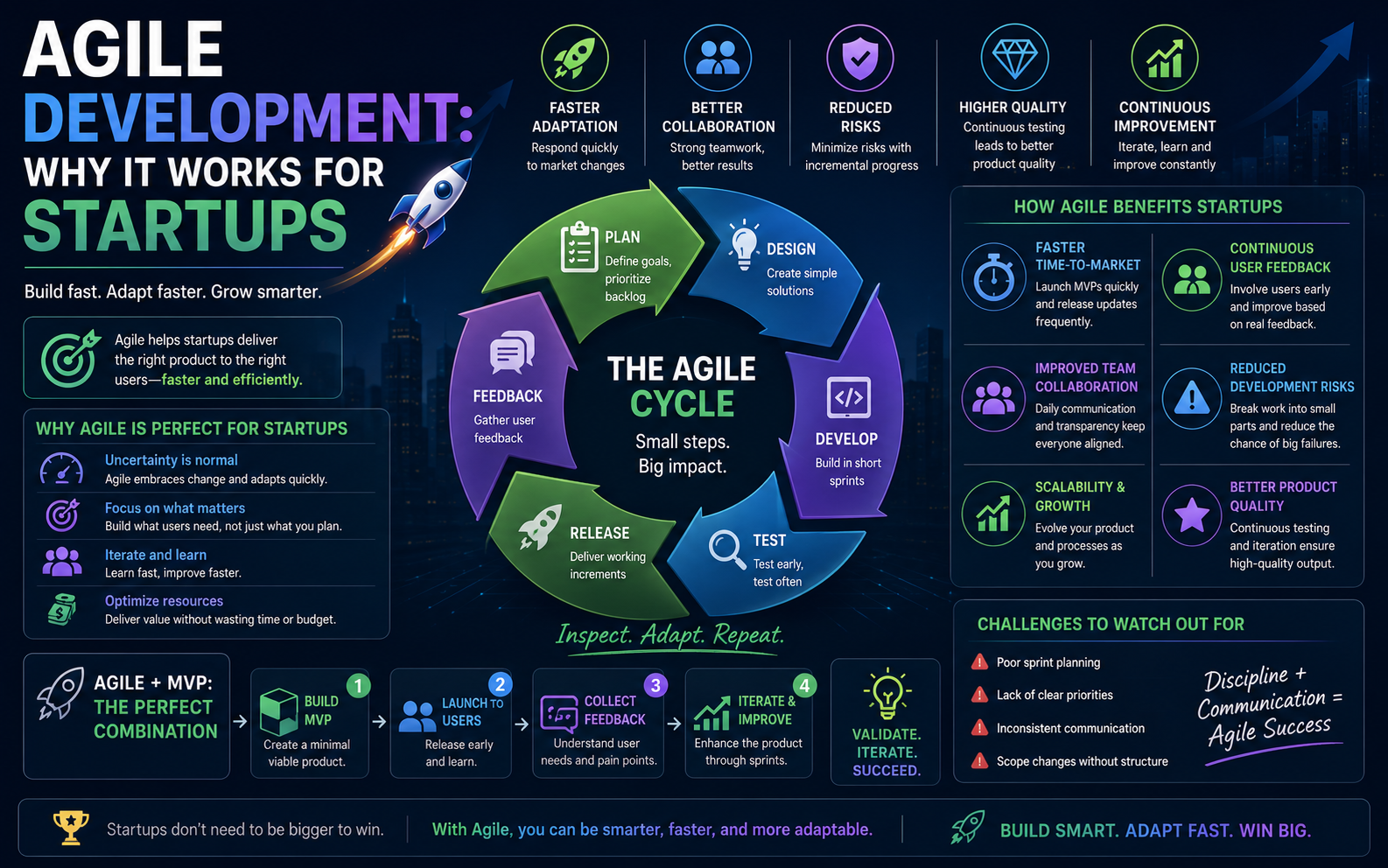
Agile Development: Why It Works for Startups
Startups operate in fast-changing environments where flexibility, speed, and continuous improvement are essential. Traditional development methods often struggle to keep up with evolving market demands and user expectations. This is why many startups adopt Agile development—a modern approach that emphasizes collaboration, rapid iteration, and adaptability.
Agile development helps startups move faster, reduce risks, and build products that better align with customer needs.
What is Agile Development?
Agile development is a flexible software development methodology that focuses on iterative progress, continuous feedback, and team collaboration. Instead of building an entire product at once, development happens in smaller cycles called sprints.
Each sprint delivers incremental improvements, allowing teams to adapt quickly based on feedback and changing requirements.
- Short and focused development cycles
- Continuous testing and improvement
- Faster delivery of features
- Greater flexibility in product development
Agile is not about building faster alone—it’s about building smarter.
Why Agile is Perfect for Startups
Startups often deal with uncertainty. Market needs can change quickly, and assumptions may not always be correct. Agile allows startups to remain flexible and responsive.
Unlike rigid development models, Agile supports experimentation and iteration, which is crucial for early-stage businesses.
Key advantages include:
- Faster adaptation to market changes
- Better collaboration across teams
- Reduced development risks
- Improved product quality
This flexibility gives startups a major competitive advantage.
Faster Time-to-Market
Speed is critical for startups. Releasing products quickly allows businesses to validate ideas, gather user feedback, and improve continuously.
Agile enables startups to:
- Launch MVPs faster
- Release updates frequently
- Respond quickly to user feedback
Instead of waiting months for a full release, startups can deliver value incrementally.
Continuous User Feedback
One of Agile’s biggest strengths is its focus on user feedback throughout the development process.
By involving users early and often, startups can ensure they are building features people actually need.
- Feedback-driven improvements
- Better alignment with customer expectations
- Reduced risk of building unnecessary features
The earlier you learn from users, the faster you improve your product.
Improved Team Collaboration
Agile promotes close collaboration between developers, designers, product managers, and stakeholders.
Daily communication and regular reviews help teams stay aligned and solve problems quickly.
Benefits of Agile collaboration include:
- Greater transparency
- Faster decision-making
- Better accountability
- Improved productivity
Strong collaboration leads to better products and more efficient workflows.
Reduced Development Risks
Startups often have limited budgets and resources, making risk management essential. Agile reduces risks by breaking development into smaller, manageable stages.
Instead of investing heavily in a complete product upfront, startups can validate assumptions gradually.
This approach helps avoid:
- Large-scale development failures
- Wasted resources on unwanted features
- Delayed product launches
Scalability and Continuous Improvement
Agile development supports long-term scalability by encouraging continuous optimization and iteration.
As startups grow, Agile helps teams:
- Adapt to increasing complexity
- Prioritize features effectively
- Maintain development efficiency
This iterative mindset ensures products evolve alongside business growth.
Agile and MVP Development
Agile works especially well with MVP strategies because both focus on learning and iteration.
A typical Agile startup workflow may look like this:
- Build a small MVP
- Launch quickly to users
- Collect feedback and analyze data
- Improve through multiple iterations
This cycle enables startups to innovate rapidly while minimizing unnecessary costs.
Challenges Startups Should Be Aware Of
While Agile offers many benefits, it also requires discipline and effective communication.
Common challenges include:
- Poor sprint planning
- Lack of clear priorities
- Inconsistent communication
- Frequent scope changes without structure
Successfully implementing Agile requires a strong process and committed teamwork.
Conclusion
Agile development is one of the most effective approaches for startups because it supports speed, flexibility, and continuous improvement. By focusing on iterative development, user feedback, and collaboration, startups can build products that adapt quickly to market needs and customer expectations.
In a fast-moving digital world, Agile helps startups stay innovative, competitive, and prepared for growth.