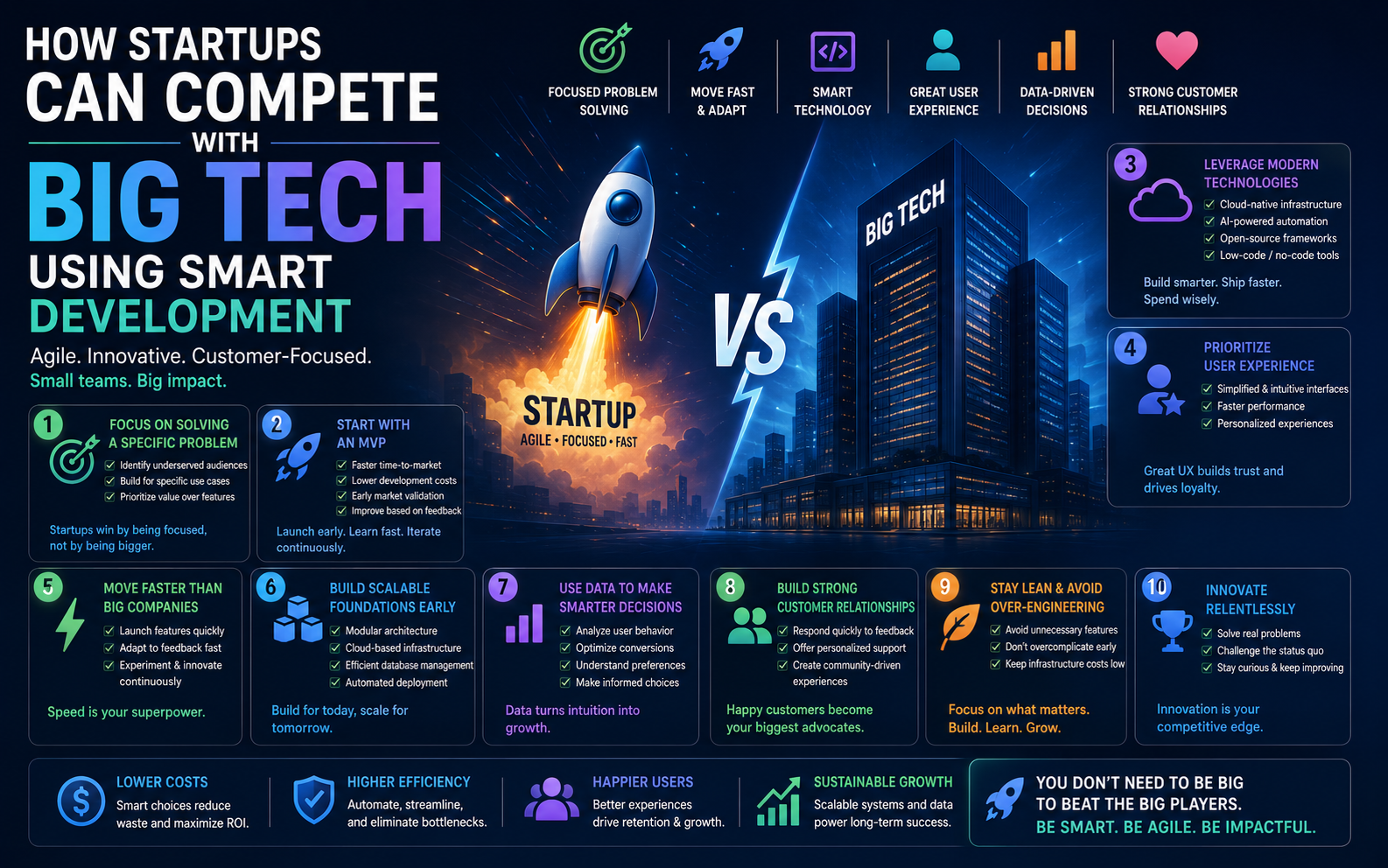
How Startups Can Compete with Big Tech Using Smart Development
Competing with large technology companies may seem impossible for startups, especially when big players have massive budgets, large teams, and global reach. However, startups have one major advantage—agility. With smart development strategies, startups can innovate faster, adapt quickly, and build products that effectively compete in the market.
Success is not always about having more resources; it’s about using resources more intelligently.
Focus on Solving a Specific Problem
Big tech companies often target broad markets, leaving gaps in niche areas. Startups can succeed by focusing deeply on a specific problem and delivering a better solution.
Instead of trying to build everything at once, startups should concentrate on solving one pain point exceptionally well.
- Identify underserved audiences
- Build solutions for specific use cases
- Prioritize value over feature quantity
Startups win by being focused, not by being bigger.
Start with an MVP
A Minimum Viable Product (MVP) allows startups to validate ideas quickly without spending excessive time or money.
Launching early helps gather real user feedback and reduces the risk of building unnecessary features.
Benefits of an MVP approach:
- Faster time-to-market
- Lower development costs
- Early market validation
- Continuous improvement based on feedback
This lean approach helps startups remain flexible and competitive.
Leverage Modern Technologies
Smart development means choosing technologies that improve speed, scalability, and efficiency.
Startups can compete effectively by using:
- Cloud-native infrastructure
- AI-powered automation
- Open-source frameworks
- Low-code and no-code tools where appropriate
These technologies reduce operational costs while enabling faster development cycles.
Prioritize User Experience (UX)
Many large platforms become overly complex over time. Startups can stand out by delivering cleaner, faster, and more intuitive experiences.
A strong user experience creates trust and encourages customer loyalty.
- Simplified interfaces improve usability
- Faster performance increases engagement
- Personalized experiences boost retention
Users stay with products that are easy and enjoyable to use.
Move Faster Than Big Companies
One of the greatest advantages startups have is speed. Large organizations often move slowly because of complex processes and approval structures.
Startups can:
- Launch features faster
- Adapt quickly to user feedback
- Experiment with new ideas rapidly
This ability to iterate quickly allows startups to stay ahead in innovation.
Build Scalable Foundations Early
Even if a startup begins small, scalability should be part of the development strategy from the beginning.
Important scalability considerations include:
- Modular software architecture
- Cloud-based infrastructure
- Efficient database management
- Automated deployment pipelines
Building scalable systems early prevents major technical problems later.
Use Data to Make Smarter Decisions
Data-driven development helps startups compete strategically instead of relying on assumptions.
By analyzing user behavior and performance metrics, startups can:
- Improve product features
- Optimize conversion rates
- Understand customer preferences
- Make informed business decisions
Smart use of data enables startups to grow efficiently.
Build Strong Customer Relationships
Big tech companies often struggle with personalization and direct customer interaction. Startups can gain an advantage by building stronger relationships with users.
- Respond quickly to feedback
- Offer personalized support
- Create community-driven experiences
Customers are more likely to stay loyal to brands that listen and adapt.
Stay Lean and Avoid Over-Engineering
Startups should focus on building what truly matters instead of creating overly complex systems too early.
Avoid:
- Unnecessary features
- Complex architectures without need
- Large infrastructure costs in early stages
A lean approach keeps development efficient and sustainable.
Conclusion
Startups may not have the same resources as big tech companies, but they have the ability to move faster, innovate smarter, and focus more deeply on customer needs. By leveraging smart development strategies, prioritizing user experience, and staying agile, startups can successfully compete and carve out their own space in the market.
In the end, innovation and adaptability often matter more than size.