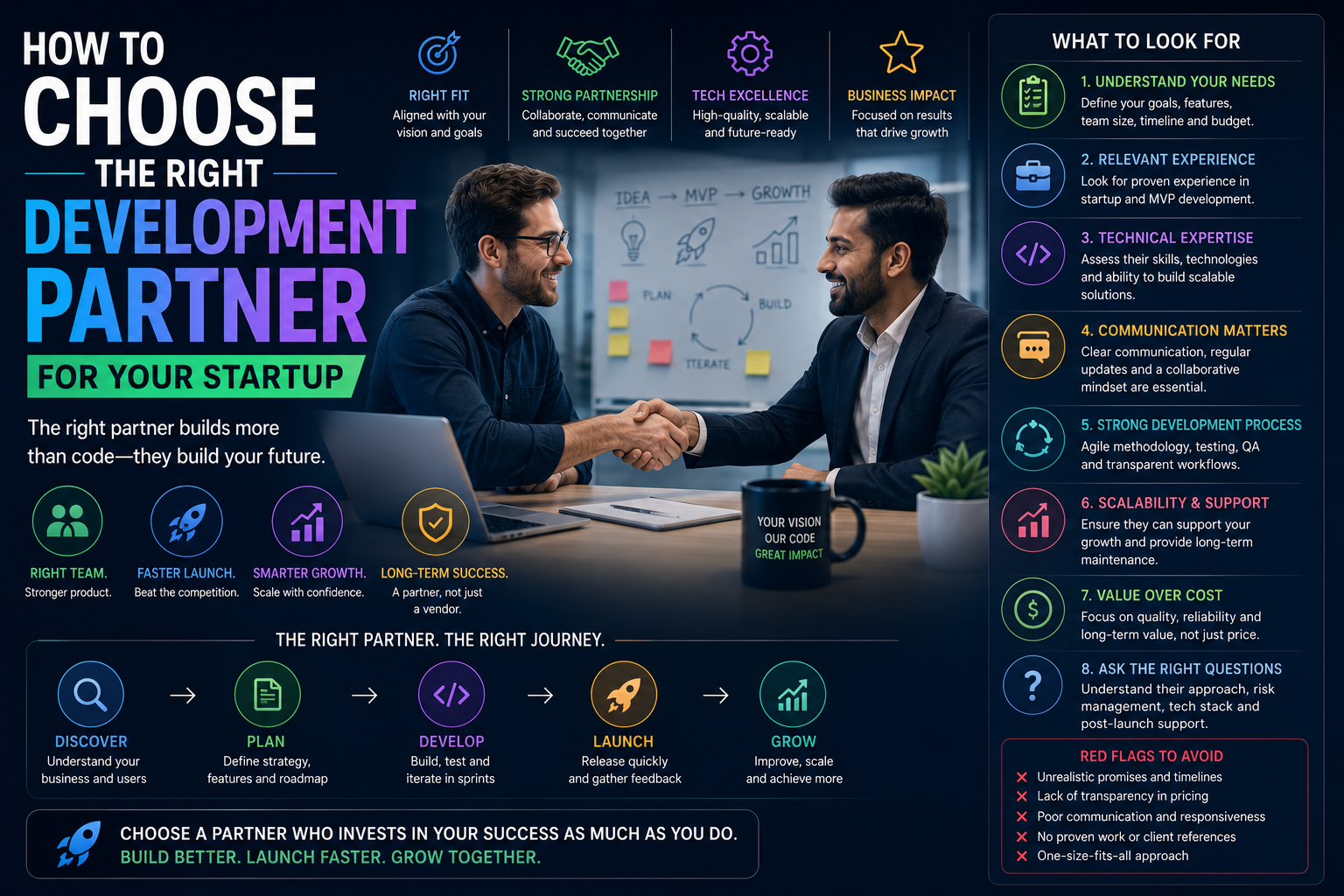
How to Choose the Right Development Partner for Your Startup
Choosing the right development partner is one of the most important decisions a startup can make. Your development team is not just responsible for writing code—they play a major role in shaping your product, user experience, scalability, and long-term success. A strong partnership can accelerate growth, while the wrong choice can lead to delays, poor quality, and wasted resources.
For startups with limited time and budgets, selecting the right development partner requires careful evaluation and strategic thinking.
Understand Your Startup’s Requirements
Before searching for a development partner, clearly define what your startup actually needs. Many startups fail to communicate their goals properly, leading to mismatched expectations and project confusion.
Start by identifying:
- Your product vision and objectives
- Core features and functionality
- Expected timeline and budget
- Scalability and long-term goals
A clear vision helps you find a partner who truly understands your business needs.
Look for Relevant Experience
Experience matters, especially in startup environments where speed and adaptability are critical.
A good development partner should have experience with:
- Startup product development
- MVP creation and rapid iteration
- Scalable software architecture
- Modern technologies and frameworks
Review their portfolio and case studies to understand the type of products they have built previously.
Evaluate Technical Expertise
Your development partner should have strong technical capabilities aligned with your project requirements.
Key areas to assess include:
- Frontend and backend development skills
- Mobile and web app expertise
- Cloud infrastructure and DevOps knowledge
- UI/UX design capabilities
- Security and performance optimization
A technically strong team can help prevent future scalability and maintenance issues.
Prioritize Communication and Collaboration
Technical skills alone are not enough. Effective communication is essential for a successful partnership.
Look for teams that:
- Provide regular progress updates
- Communicate clearly and transparently
- Understand your feedback and goals
- Work collaboratively instead of transactionally
Great products are built through strong collaboration, not just coding.
Assess Their Development Process
Understanding how a company approaches development can reveal a lot about their reliability and professionalism.
An ideal development partner should follow:
- Agile development methodologies
- Structured sprint planning
- Regular testing and quality assurance
- Continuous feedback and iteration
A clear process helps ensure smoother execution and better product quality.
Check Scalability and Long-Term Support
Your startup may begin with an MVP, but your product will evolve over time. Your development partner should be capable of supporting future growth.
Important considerations include:
- Ability to scale the development team
- Long-term maintenance and support
- Experience handling growing user bases
- Flexibility for future feature expansion
Choosing a partner who can grow with your startup reduces the need for costly transitions later.
Balance Cost with Quality
Startups often operate with limited budgets, but choosing the cheapest option can lead to poor results.
Instead of focusing only on cost, evaluate:
- Value delivered for the price
- Technical quality and reliability
- Communication efficiency
- Long-term partnership potential
A slightly higher investment in a reliable partner often saves significant costs in the future.
Ask the Right Questions
Before finalizing a development partner, ask detailed questions about their process and capabilities.
Some important questions include:
- How do you handle project timelines and delays?
- What technologies do you recommend and why?
- How do you approach scalability and security?
- What does post-launch support include?
These discussions help clarify expectations and avoid misunderstandings later.
Red Flags to Avoid
Be cautious of development partners who:
- Promise unrealistic timelines
- Lack transparency in pricing
- Avoid discussing technical details
- Have poor communication practices
- Cannot provide previous work examples
Identifying these warning signs early can prevent major problems later.
Conclusion
Choosing the right development partner is about more than hiring developers—it’s about building a long-term relationship that supports your startup’s vision and growth. The ideal partner should combine technical expertise, clear communication, scalability, and a strong understanding of startup challenges.
By taking the time to evaluate experience, processes, and collaboration style, startups can find a development partner that helps transform ideas into successful digital products.