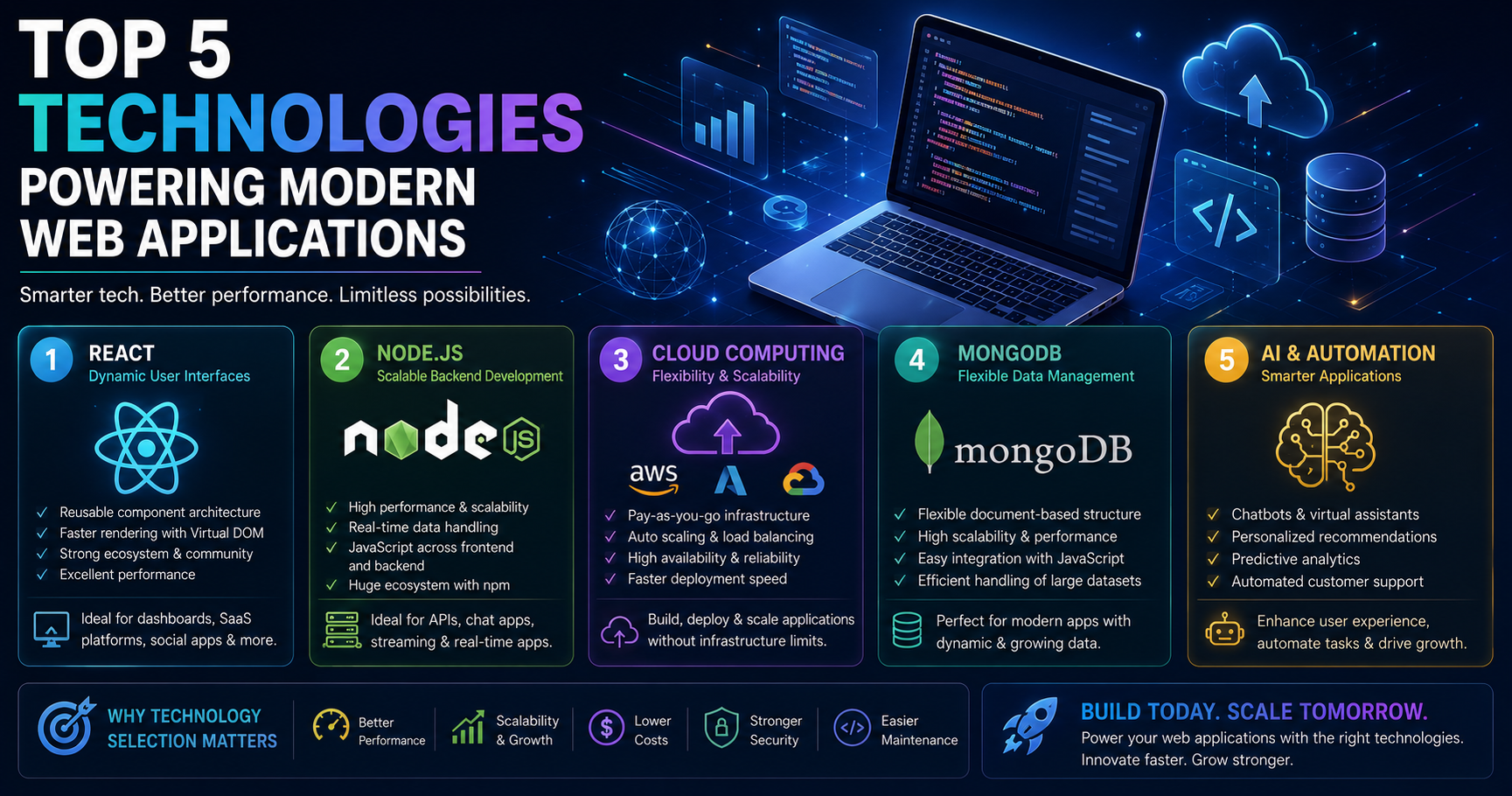
Top 5 Technologies Powering Modern Web Applications
Modern web applications are faster, smarter, and more scalable than ever before. Behind these advanced digital experiences are powerful technologies that help businesses build responsive interfaces, handle large amounts of data, and deliver seamless performance across devices.
Choosing the right technologies is essential for creating secure, scalable, and high-performing web applications. Here are the top five technologies powering modern web applications today.
1. React for Dynamic User Interfaces
React has become one of the most popular frontend libraries for building interactive and responsive user interfaces. Developed for creating fast and component-based applications, React enables developers to build highly dynamic web experiences.
Why businesses prefer React:
- Reusable component architecture
- Faster rendering with virtual DOM
- Strong ecosystem and community support
- Excellent performance for modern applications
Modern users expect smooth and interactive experiences, and React helps deliver exactly that.
React is widely used in dashboards, SaaS platforms, social applications, and enterprise-level web products.
2. Node.js for Scalable Backend Development
Node.js allows developers to build fast and scalable server-side applications using JavaScript. Its event-driven and non-blocking architecture makes it ideal for handling real-time applications and high user traffic.
Key benefits of Node.js include:
- High performance and scalability
- Real-time data handling
- Faster development with JavaScript across frontend and backend
- Large package ecosystem through npm
Startups and businesses often choose Node.js for APIs, chat systems, streaming platforms, and scalable backend services.
3. Cloud Computing for Flexibility and Scalability
Cloud platforms like AWS, Azure, and Google Cloud have transformed how modern applications are deployed and managed.
Instead of relying on expensive physical infrastructure, businesses can now scale resources dynamically based on demand.
Advantages of cloud-based development:
- Pay-as-you-go infrastructure
- Automatic scaling and load balancing
- High availability and reliability
- Improved deployment speed
Cloud computing allows businesses to scale without worrying about infrastructure limitations.
Cloud-native applications are now considered the standard for modern web development.
4. MongoDB for Flexible Data Management
Modern applications often require handling large amounts of dynamic and unstructured data. MongoDB, a NoSQL database, provides the flexibility needed for such applications.
Why developers choose MongoDB:
- Flexible document-based structure
- High scalability and performance
- Easy integration with JavaScript-based stacks
- Efficient handling of large datasets
MongoDB is commonly used in MERN stack applications and products that require rapid iteration and scalability.
5. Artificial Intelligence and Automation
AI is becoming a major part of modern web applications. Businesses are integrating AI-powered features to improve personalization, automation, and decision-making.
Popular AI use cases include:
- Chatbots and virtual assistants
- Personalized recommendations
- Predictive analytics
- Automated customer support
AI helps businesses create smarter applications that improve user engagement and operational efficiency.
Why Technology Selection Matters
The technologies used in a web application directly impact:
- Performance and speed
- Scalability and growth potential
- Development costs and timelines
- Security and maintainability
Choosing the wrong stack can create technical debt and scalability challenges later.
Building a Future-Ready Web Application
Modern web applications should be designed with future growth in mind. Businesses should focus on technologies that support:
- Scalability and flexibility
- Faster development cycles
- Better user experiences
- Integration with emerging technologies
A future-ready tech stack helps businesses remain competitive in a rapidly evolving digital landscape.
Conclusion
The success of modern web applications depends heavily on the technologies powering them. React, Node.js, cloud computing, MongoDB, and AI are shaping the future of digital products by enabling faster, smarter, and more scalable solutions.
By leveraging the right technologies, businesses can build web applications that not only meet current demands but are also prepared for future growth and innovation.